Protecting forests is not only about protecting trees. For communities living around them, forests are part of their livelihoods, knowledge, culture, and heritage that they seek to preserve for future generations. However, forest protection also presents challenges when communities need to meet their economic needs amid limited livelihood options that provide direct benefits.
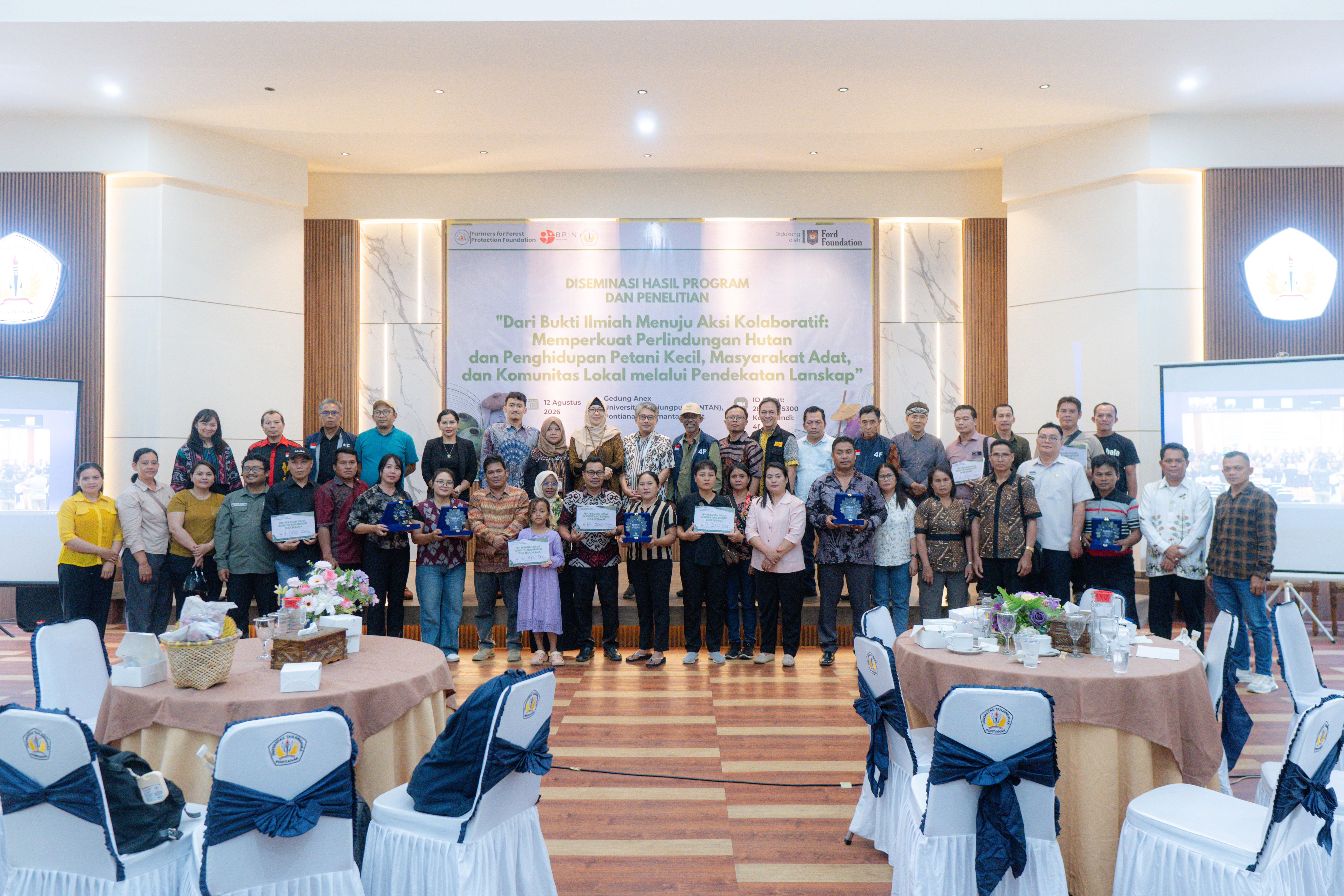
This issue emerged as one of the key topics discussed during the Seminar and Festival on Program and Research Results Dissemination, held on 12 August 2026 at Tanjungpura University (UNTAN), Pontianak, under the theme “From Scientific Evidence to Collaborative Action: Strengthening Forest Protection and the Livelihoods of Smallholder Farmers, Indigenous Peoples, and Local Communities through a Landscape Approach.” The event brought together representatives of farmers, Indigenous Peoples, and local communities from 11 villages supported by 4F in Sanggau, Sekadau, and Sintang Regencies, West Kalimantan, as well as Sukamara Regency, Central Kalimantan, together with national, regional, and village governments, academics, researchers, civil society organizations, and the private sector.
For the Yayasan Petani Pelindung Hutan / Farmers for Forest Protection Foundation (4F), the gathering provided a space to bring together community experiences and knowledge with scientific evidence, while also creating dialogue among smallholder farmers, Indigenous and local communities, research institutions, universities, government, and the private sector. This approach is grounded in the understanding that communities are not merely beneficiaries, but also possess important knowledge about the landscapes where they live and manage natural resources.
When Community Knowledge Meets Scientific Evidence
One of the issues discussed during the event was how forest protection can go hand in hand with community livelihood needs. For communities in the 11 villages supported by 4F, customary forests and tembawang are not simply areas that need to be protected. They are also sources of food, medicinal plants, non-timber forest products (NTFPs), and knowledge passed down from one generation to another.
Therefore, community experiences need to become part of the process of generating knowledge about the landscape. Bringing local knowledge together with scientific research is important to strengthen understanding of the benefits of forests while identifying management opportunities that can support community livelihoods.

Figure 1. The NTFP booth from Embala Village displaying woven rattan products, including bags, baskets, and trays, at the NTFP Festival at the Anex Building of Tanjungpura University.
This hope was expressed by Mr. Daniel, Head of Embala Village:
“Thank you to 4F. We hope that through all the activities we have carried out together, the forest will remain protected and sustainable, so that in the future our children and grandchildren can enjoy and benefit from what we have done together.”
A similar statement was made by Mr. Ramos, Head of Marita Village:
“Our hope is certainly that with the presence of 4F, many matters related to the forest can become important issues for us to consider together, so that the forest in Marita Village remains in harmony and sustainable. As the Head of Marita Village, I invite all of us to work together to protect the forests in our respective areas, especially here in Marita Village, and to continue working with 4F to protect the forest with good intentions.”
Both statements demonstrate that forest protection is viewed as a shared responsibility to ensure that its benefits can continue to be enjoyed by future generations. This perspective was further strengthened by the research findings presented during the event.
One of the studies examined the relationship between forest or tembawang conditions, soil microorganisms, and plant health. Research conducted on oil palm plantations surrounding tembawang found that areas located closer to forests or tembawang had greater soil microorganism diversity, while the plants also appeared healthier than those located farther away from forest areas.
These findings provide a perspective that forests surrounding agricultural land are important not only for biodiversity, but also potentially for supporting the health of agricultural ecosystems. For communities, this scientific evidence strengthens their understanding of the ecological functions of forests and tembawang, which they have long protected as sources of livelihood and heritage for future generations.
From Community Experience to Action
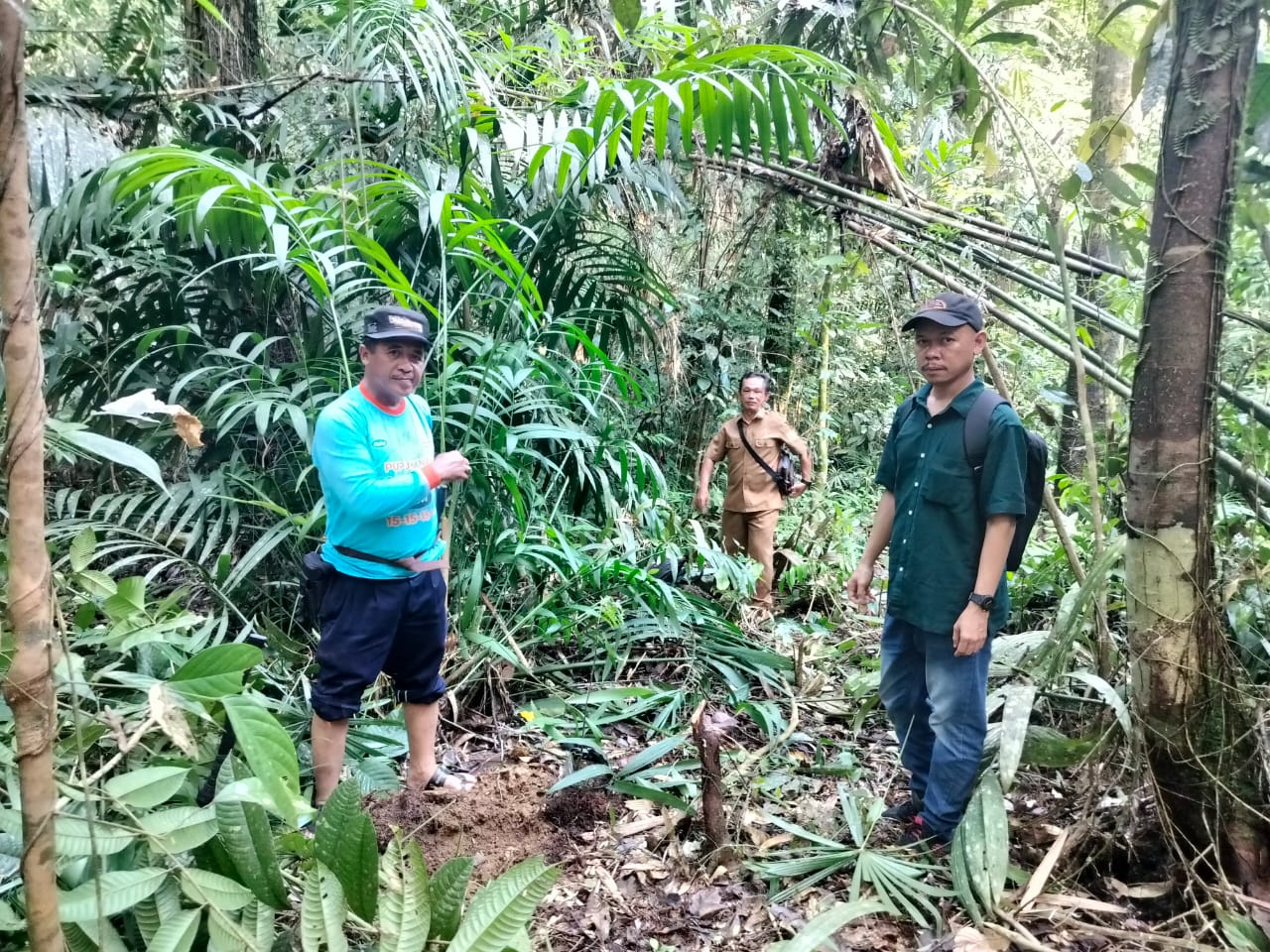
The meeting between local knowledge and research was then translated into research and joint learning activities with communities. In February 2026, 4F, together with researchers from BRIN, conducted research to identify pathogenic fungi and soil microorganisms, involving 30 farmers from Menyabo, Gunam, and Embala villages, with samples collected from six locations in Sanggau.
The analysis identified Rigidoporus microporus, a pathogenic fungus that causes white root disease (JAP) and was found in areas previously planted with rubber (Hevea brasiliensis). The disease is one of the most damaging and lethal threats to various tropical plantation crops. This finding provided important information about a pathogen that has the potential to affect plantation crops in the area.

Figure 2. The fruiting body of Rigidoporus microporus found in an oil palm plantation in Gunam Village, Sanggau Regency.
In addition to identifying pathogenic fungi, soil samples were also analyzed to identify microorganisms that could support soil health. One of the outcomes was the development of a local Azotobacter strain from Sanggau as a biofertilizer. Through collaboration between BRIN and 4F, Azotobacter was developed because of its potential for nitrogen fixation, phytohormone production, phosphate solubilization, and soil structure improvement.
The research findings were introduced to communities through training held on 10–11 August 2026 at the Embala Village Meeting Hall, Sanggau Regency. The training was attended by 31 participants from Marita, Embala, and Gunam villages, consisting of 22 men and 9 women. Participants learned about the benefits of Azotobacter for soil and plant health, followed by discussions and hands-on practice in producing and applying biofertilizer.

Figure 3. Training and development of local Azotobacter from Sanggau as a biofertilizer in Embala Village, attended by farmers and community members from Gunam, Marita, and Menyabo villages.
As part of the follow-up, BRIN and 4F distributed Azotobacter biofertilizer prototypes to participants to be applied to community crops, while their development and impacts on plants were observed. In this way, the research findings began to be translated into learning and practice at the community level. The next stage is directed toward strengthening field trials together with farmer groups and relevant stakeholders.
In addition to Azotobacter development, the follow-up to the collaboration includes calibration of tembawang spatial data, field testing of Azotobacter, integration of relevant data into spatial planning processes, and the preparation of cross-disciplinary publications. These steps are expected to ensure that research findings continue to be developed and utilized to support landscape management and community livelihoods.
For 4F, this process is important to ensure that research findings do not stop at reports, but can be translated into learning and joint practices with communities. Through these activities, research-based innovations are beginning to be introduced and tested together with farmers as an initial step toward wider application in supporting landscape management and community livelihoods.
Forest Protection Must Provide Benefits
Another challenge in forest protection is ensuring that communities receive economic benefits that can support the sustainability of forest management. The Sukamara Regency Government stated that communities would be more encouraged to maintain forests when clear economic benefits are available. Oil palm is attractive because markets are relatively accessible and the risks are considered lower, while the development of NTFP markets still faces challenges.

Figure 4. The NTFP booth from Setawar Village displaying woven rattan products, forest products, and medicinal plants.
A similar situation is experienced by the people of Setawar. Isa Kennedy, a farmer and forest guardian, explained that oil palm has economic appeal, but communities are also increasingly concerned about the decline of customary forests and tembawang, as well as the loss of traditional medicinal plants. He also emphasized the need for carbon incentives for communities that protect forests.
This demonstrates that forest protection needs to go hand in hand with strengthening community livelihoods. The development of NTFPs and agroforestry, expanded market access, tenure security, and incentive mechanisms for forest guardians are important components that need to be continuously developed.
In this context, 4F also creates spaces for dialogue so that community needs and experiences can be brought together with government, universities, research institutions, and other partners to identify management options that can protect forests while supporting community livelihoods.
Sustainable Landscape Festival: Celebrating Forests, Local Products, Culture, and Collaboration

Figure 5. Students from Tanjungpura University (UNTAN) trying kelampai fruit (Elateriospermum tapos) at the Telaga Dua Village booth.
The Sustainable Landscape Festival was part of the dissemination activities at Tanjungpura University (UNTAN), introducing the economic potential, knowledge, and culture of communities in utilizing local resources. The festival was attended by 11 villages supported by 4F and featured 69 NTFP products, including food products, medicinal plants, and handicrafts.
One of the main activities was the NTFP Product Competition, which assessed product quality, innovation, development potential, as well as the stories behind the products and their contributions to communities and forest conservation. The festival also formed part of the provision of forest protection incentives through the Direct Access Financing (DAF) mechanism provided by 4F.
The diversity of products was reflected in kelampai fruit and woven mats from Telaga Dua Village, medicinal plants and woven fans from Setawar Village, woven baskets from Tapang Perodah Village, mango tuak and dragon fruit tuak from Marita Village, as well as various food products and medicinal plants from other villages.
For the people of Setawar, for example, rattan weaving is knowledge and a skill passed down through generations. One of the most popular products is the ronjong, traditionally used when going to the forest, including for carrying food supplies. Prices range from around IDR 35,000 for simple products to IDR 200,000–300,000 or more, depending on size, pattern, and complexity.
Mrs. Marini explained:
“Each weaving design in every village is definitely different. Rattan is obtained from the forest as well as rubber gardens and is still available around the village. The processing is done manually, starting from removing the thorns, cutting, splitting, drying, flattening, and finally weaving.”
This demonstrates that NTFP products have not only economic value, but also carry community identity and knowledge.
In the competition, Setawar Village won first place, Telaga Dua Village second place, Tapang Perodah Village third place, and Marita Village received the Favorite Award.
For participants, the festival also became a space to introduce their products, learn from other villages, and gain motivation to continue developing their NTFP potential.
Mrs. Yus from Telaga Dua Village said:
“We are happy to see forest products from other villages and to introduce the forest products from our own village.”
This experience became a learning opportunity and motivation for participants to develop and improve their products.
Thus, the NTFP Festival was not merely an exhibition and competition, but also a space to introduce and strengthen community knowledge, skills, cultural identity, economic potential, and forest protection efforts in each village.
Collaboration among Government, Researchers, and Communities
Landscape protection requires collaboration among different parties whose roles complement one another. The seminar and festival provided a space to bring community knowledge together with scientific evidence.
Communities bring their experiences and knowledge of the history, functions, and values of forests and tembawang passed down through generations, while universities and research institutions contribute by generating and validating scientific knowledge. Governments provide support through policies and recognition of community rights, while civil society organizations and the private sector can strengthen the development of sustainable management models.
In this process, 4F plays a role in connecting communities with researchers, government, universities, and other stakeholders. This collaboration has been strengthened through institutional partnerships with BRIN and the Faculty of Forestry at UNTAN.
Together with BRIN, 4F has an MoU for studies on the influence of forest conservation and management on land productivity and plant disease control. Meanwhile, cooperation with UNTAN and the Faculty of Forestry at UNTAN is directed toward implementing the Tri Dharma of Higher Education through forest protection and sustainable natural resource management, including within the framework of the Diktisaintek Berdampak program.
Collaboration with local governments is also an important part of connecting knowledge and research findings with regional development needs. The involvement of the governments of Sanggau, Sekadau, Sintang, and Sukamara Regencies provides space to discuss forest protection, community economic development, strengthening of tembawang spatial data, and its utilization in regional planning.
One concrete form of collaboration was realized through an agreement between the Sanggau Regency Government and 4F, signed by Regent Yohanes Ontot on 11 August 2026, to strengthen sustainable development governance based on a jurisdictional approach.
The five-year agreement covers the empowerment of customary law communities, forest and natural resource protection, agroforestry and sustainable economic development, strengthening village institutions, and multi-stakeholder partnerships. Technical and operational follow-up will be set out through a Cooperation Agreement (PKS).
Through this collaborative network, community knowledge, research, policies, and field practices can become interconnected. For 4F, this collaboration is part of an effort to ensure that knowledge does not stop at research or dissemination forums, but can be translated into learning, innovation, policy, and collective action to strengthen forest protection while supporting community livelihoods.
What Is Beginning to Change?
The meeting between communities, researchers, government, and partners has created stronger opportunities to connect local knowledge, scientific evidence, and decision-making processes.
Communities are not only receiving information, but are also sharing their experiences and needs, while research findings provide new perspectives on the importance of forests for ecosystem and agricultural health.
This process is beginning to generate more concrete follow-up actions, including through institutional commitments, government collaboration, and the application of research findings in the field.
One example is the agreement between the Sanggau Regency Government and 4F on 11 August 2026, which serves as a framework for cooperation on the empowerment of customary law communities, forest and natural resource protection, agroforestry and sustainable economic development, and the strengthening of village institutions. Technical and operational follow-up will be set out through a PKS.
For 4F, these changes demonstrate that knowledge generated through research and community experience is beginning to have space to be translated into action. The process will continue to focus on testing agricultural innovations, strengthening spatial data, developing NTFPs, and supporting policies that strengthen forest protection while sustaining community livelihoods.
From Evidence to Action
The seminar and festival are part of a longer collaborative process. Community knowledge and research findings provide a foundation for building collective action, supported by government, universities, research institutions, civil society organizations, and other partners.
Ultimately, these efforts are directed toward ensuring that forests remain protected, community livelihoods continue to thrive, and knowledge can be passed on to future generations.
The meeting between community voices, scientific evidence, and collaboration is a step toward turning knowledge into meaningful action.