
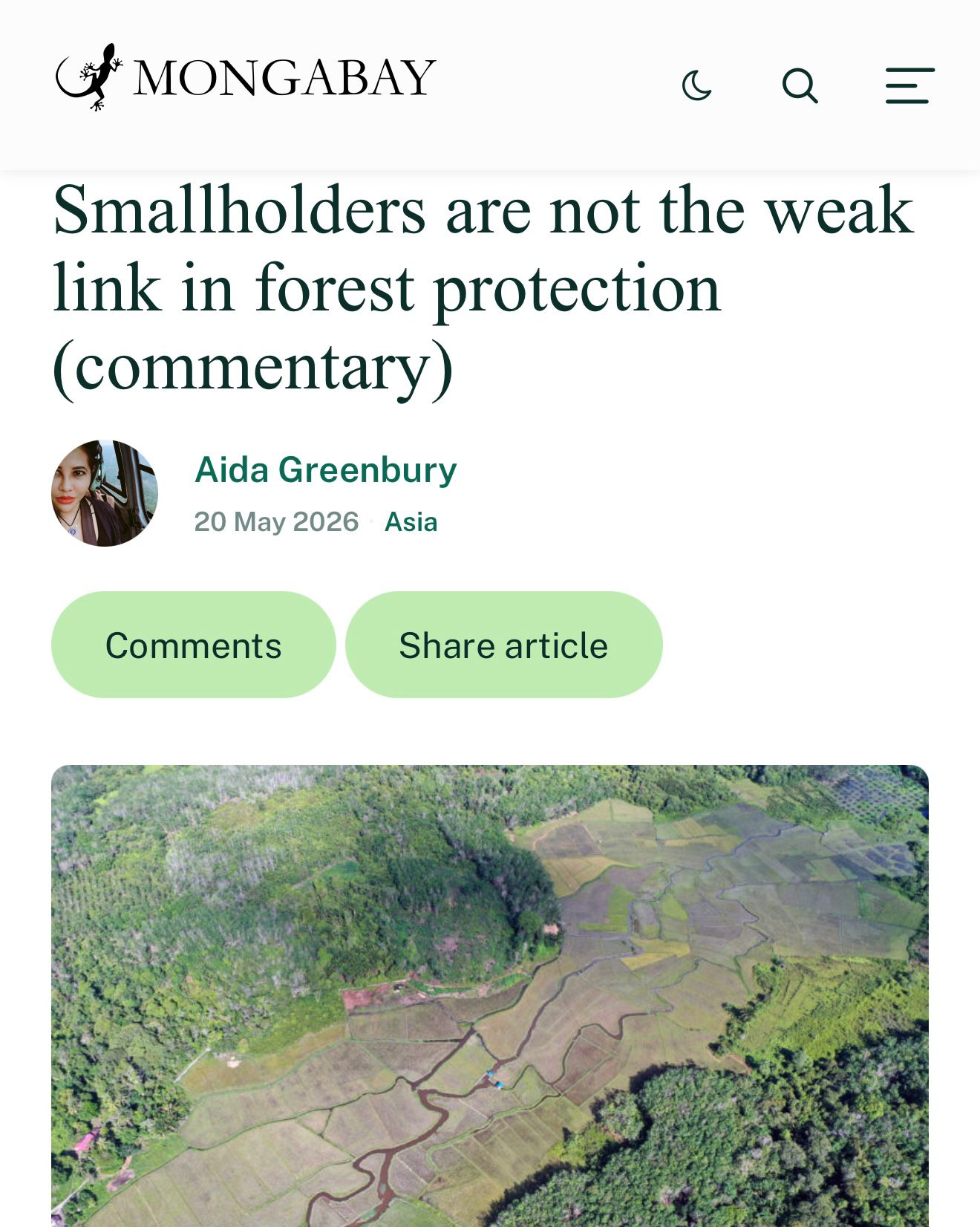
On 20 May 2026, Aida Greenbury, a member of the 4F's Board of Trustees, published an article on Mongabay. Aida’s article was published in English under the title “Smallholders are not the Weak Link in Forest Protection”. This article outlines Aida’s perspective on the role of smallholders and local communities in sustainable forest conservation efforts. In her view, within deforestation-free supply chains, smallholders are often misperceived as a source of risk and a burden for corporations. In reality, it is precisely those who live closest to the forest who possess the strongest motivation to safeguard the sustainability of their environment. Complex global certification standards and market traceability requirements often burden smallholders with high costs. Many of them face the threat of losing market access simply because they lack formal maps, legal documents, or sufficient capital to meet international regulatory compliance requirements, which tend to be top-down in nature.
In order to address this issue, initiatives such as the High Carbon Stock Approach (HCSA) have been developed. However, this approach is only suitable for companies with substantial resources. When these strict standards are imposed top-down on smallholder farmers (with plots of 10–15 hectares), compliance requirements such as mapping and proof of traceability place a financial burden on them.
To close this gap, HCSA, together with farmers’ organisations and the Farmers for Forest Protection Foundation (4F), subsequently developed the Simplified Deforestation-Free Toolkit for Smallholders in Indonesia (2024). Rooted in local knowledge and the principle of free, prior and informed consent, this toolkit helps communities independently to map areas of high conservation value. The toolkit then serves as a guideline for 4F in supporting smallholder farmers to protect forests and improve their livelihoods through sustainable agricultural practices. Through partnerships with multiple stakeholders, including the government, indigenous communities, NGOs, companies, universities and researchers (BRIN), 4F is committed to and focused on supporting farmers in securing legal recognition of customary forests, land rights certainty, financial incentives, and increased crop yields, ensuring that conservation does not come at the expense of their livelihoods.
In West Kalimantan, the implementation of 4F’s initiatives is taking shape. Through collaboration with the Pemangku Poyo Tono Hibun (PPTH) indigenous community group in Sanggau, 4F is working to support the Hibun indigenous community in securing legal certainty and clarity regarding their customary lands. Furthermore, 4F, in collaboration with BRIN, is conducting a study on the impact of forest conservation and management on land productivity and the control of plant diseases. This research has revealed that the productivity of farmers’ land situated near forests or conservation areas tends to increase and is less susceptible to diseases or pests. This demonstrates that forest conservation efforts have a direct impact on farmers’ incomes.
Therefore, according to Aida, the existence of the Farmers for Forest Protection Foundation (4F) is of crucial importance and highly relevant to the current needs of farmers and local communities, both for the sustainability of agricultural enterprises and for the preservation of landscape integrity. 4F’s commitment has been demonstrated by bridging research, conservation, welfare improvement, and market access to better serve smallholder farmers and local communities. This initiative aims to emphasise that the future of forest protection in Indonesia and the well-being of smallholder farmers depend heavily on ensuring fair rights and opportunities for smallholder farmers and local communities.
To read Aida’s full article, please visit this link.