
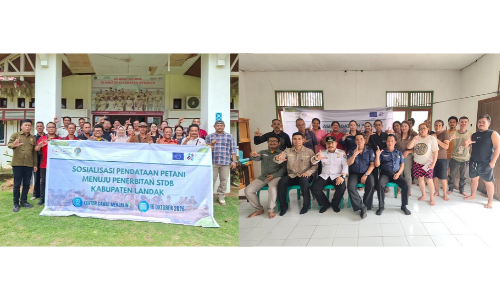
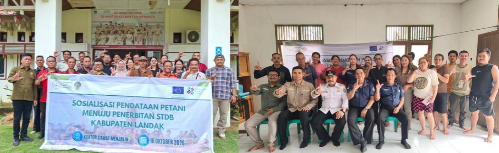
Documentation of e-STDB registration outreach in Sebatih Village on 14 October 2026 and Menjalin Subdistrict on 16 October 2026
Sebatih and Menjalin, WEST KALIMANTAN — With support from the International Trade Centre (ITC) and in collaboration with relevant stakeholders, the Farmers for Forest Protection Foundation (4F) conducted outreach sessions on the electronic registration of plantation cultivation businesses (e-STDB) in Sebatih Village, Sengah Temila Subdistrict, on 14 October 2026, and in Menjalin Subdistrict on 16 October 2026. These activities followed the Landak District-level outreach held on 29 September 2026 and formed part of efforts to strengthen coordination and readiness for registering independent oil palm smallholders. Through these activities, 4F and its partners are encouraging the collection of accurate, consistent, and verifiable data on farmers and their plantations to support smallholder plantation governance and supply-chain traceability.
The outreach in Sebatih Village was attended by 25 participants, while the session in Menjalin Subdistrict had 23 participants. Participants represented subdistrict and village governments, Village Consultative Bodies (BPD), village officials, customary leaders, women leaders, companies, and local communities and farmers. Involving these stakeholders was important for building a shared understanding of the purpose and process of e-STDB registration, the documents required—such as national identity cards (KTP), family cards (KK), and land legality documents—and the respective roles in registration and field verification involving local enumerators and plantation owners. During discussions at both locations, participants raised questions and concerns, including land located within or overlapping company Business Use Rights (HGU) areas, administrative requirements, clarity of land boundaries, and the coordination needed before registration begins.
Why Is the Quality of Smallholder Plantation Data Important?
Clear information on plantation land status, boundaries, and area is essential for electronic registration through e-STDB. This information helps ensure that plantation records are accurate and verifiable, particularly when the area stated in documents differs from field measurements or when there may be overlap with company Business Use Rights (HGU) areas.
Bayu Supianto of the Landak District Plantation and Livestock Agency explained that the Plantation Cultivation Business Registration Certificate (STDB) is a registration document containing information about the business operator and plantation location. STDB serves as an identity document for a farmer’s plantation business; it is not a land ownership certificate.
“This registration is expected to improve plantation administration, strengthen the accuracy of land data, and support farmers’ access to government assistance programmes and compliance with traceability requirements for plantation products,” Bayu explained.
To achieve these objectives, e-STDB registration must ensure that information is complete and accurate, including farmers’ identities, cultivated commodities, plantation locations and areas, coordinates, and supporting documents. This information must be recorded carefully to facilitate data checks and verification, including confirmation of land boundaries.
STDB does not, by itself, establish land rights or resolve land disputes. The registration process must therefore take into account document clarity, information accuracy, and the checking of data and coordinates in accordance with applicable rules and procedures.
At the Village Level: Understanding Registration Needs and Processes
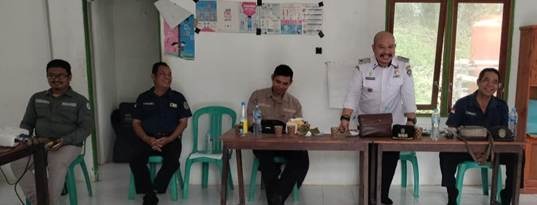
Figure 1. Opening remarks by Simon Mamburaja, S.E., Head of Sengah Temila Subdistrict
During the outreach session in Sebatih Village, held at the Pakupat Hamlet meeting hall, participants discussed administrative requirements, consistency in reported plantation areas, and the importance of checking coordinates. The discussion also highlighted the need for communication among subdistrict and village governments, farmers, enumerators, and the facilitation team so that everyone understands the purpose and stages of registration. Simon Mamburaja, Head of Sengah Temila Subdistrict, emphasised that communication and cooperation among the subdistrict government, village government, 4F team, and community are essential to prevent misunderstandings about land status.
“STDB registration is not merely an administrative matter; it is also an effort to establish reliable land data and promote proper business administration for farmers. Through this registration, we hope farmers will receive protection in relation to the legality of their businesses. I would also like to emphasise that STDB registration will not take away residents’ land rights and is not a mechanism for imposing new taxes. Rather, it is one form of government protection for farmers,” said Simon Mamburaja, S.E., Head of Sengah Temila Subdistrict.
He also emphasised the importance of government support. Simon Mamburaja, S.E., Head of Sengah Temila Subdistrict, stated:
“The Subdistrict Government fully supports a transparent and accurate registration process without interference, in order to achieve orderly and sustainable governance of smallholder plantations.”
On the same occasion, Pegin, Secretary of Sebatih Village, encouraged residents to understand the purpose and benefits of STDB, including the community’s role in supporting a more orderly registration process.
“I encourage all participants to pay close attention to this outreach session so that they understand the purpose and benefits of the Plantation Cultivation Business Registration Certificate (STDB). This understanding is important so that residents know what STDB is for and can support a more orderly plantation business registration process,” said Pegin, Secretary of Sebatih Village.
As a next step, participants discussed the documents required and coordination mechanisms for field registration. The enumerator team also planned document collection and coordinate mapping, with an initial target of mapping 50 plantation plots within two months.
At the Subdistrict Level: Strengthening Coordination Across Villages
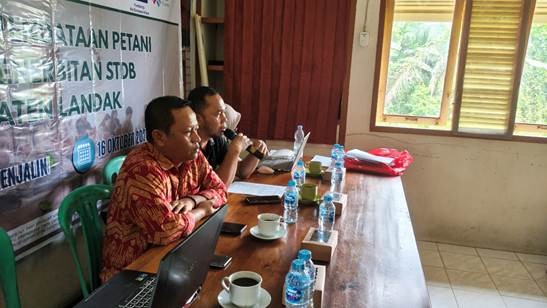
Figure 2. Discussion with participants and stakeholders in Menjalin Subdistrict
The outreach session in Menjalin Subdistrict involved participants from two villages: Sepahat and Menjalin. It was held in the Menjalin Subdistrict Head’s Office hall. Discussions focused on coordinating registration activities in Menjalin and Sepahat villages, including technical questions about plantation locations, document completeness, and consistency in administrative boundary information.
The discussion was intended to inform preparations for coordinated data collection and verification. Alberto, Head of Menjalin Subdistrict, also conveyed the importance of continued support:
“We hope this programme will not stop at outreach sessions but will be followed by ongoing field assistance, so that communities fully understand the process, experience the programme’s benefits, and have confidence in the registration process and its results.”
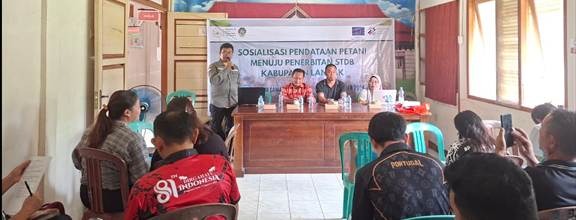
Figure 3. Harits Yowansyah, 4F Programme Manager, explains the data collection process and digital registration tools.
Harits Yowansyah, 4F Programme Manager, explained the data collection process and the digital tools available for registration. These tools can be used for both online and offline data collection. In addition to explaining the process and tools, he demonstrated how to complete the forms and map plantation polygons.
The registration process must ensure that farmers understand its purpose, the types of information being collected, and how the data will be used, and that they can participate voluntarily. Personal information and plantation-location data must be handled carefully, with due regard for consent, access, and data security. This principle is known as Free, Prior and Informed Consent (FPIC), or Persetujuan atas Dasar Informasi Awal Tanpa Paksaan (PADIATAPA) in Indonesian.
Connecting Registration with Traceability
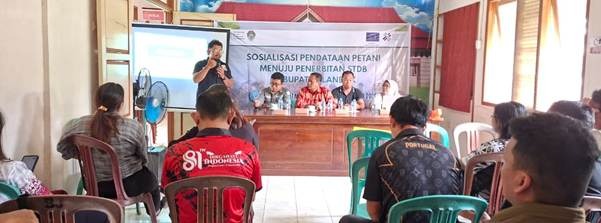
Figure 4. Presentation by a representative of PT Hilton
Barselinus Barce Sudarman, Head of the Environmental Division and person responsible for external fresh fruit bunches (FFB) at PT Hilton, explained that the oil palm industry needs information on the origin of fresh fruit bunches (FFB) to support supply-chain traceability. Well-organised plantation data can help stakeholders trace production origins and carry out checks as needed. Farmers may also gain opportunities to access government support programmes, such as improved seedlings, production inputs, Good Agricultural Practices (GAP) training, and plantation replanting assistance, subject to applicable requirements.
The Menjalin Subdistrict Government and the governments of Menjalin and Sepahat villages support further coordination with the 4F team. Farmers who meet the requirements will be assisted in applying for STDB in accordance with applicable regulations.
From Outreach to Evaluation: Assessing Understanding and Preparing Next Steps
Through a series of outreach activities at district, village, and subdistrict levels, 4F and its stakeholders are working to strengthen readiness and coordination for e-STDB registration. These efforts align with ITC’s support to improve the quality of data collection and verification, geospatial information, and data access and security governance, thereby supporting traceability and better smallholder plantation management.
Survey results from the e-STDB outreach sessions in Sebatih Village and Menjalin Subdistrict indicate that participants felt their understanding of the importance of farmer and land registration had improved. In Sebatih, 84% of respondents reported improved understanding, while in Menjalin, all respondents reported an improvement after attending the activities. Participants also considered the sessions relevant to local needs and associated e-STDB with better farmer and plantation data, potential access to assistance, stronger farmer organisations, and supply-chain traceability. However, participants’ understanding of how e-STDB registration relates to landscape mapping, data verification, and traceability varied. These findings highlight the importance of continued assistance to help participants apply what they have learned to registration processes and improved management of farmers’ plantations.
Through these outreach activities, from the district level to villages and subdistricts, 4F and its stakeholders are promoting a more coordinated, accurate, and verifiable e-STDB registration process while supporting plantation governance that takes traceability and environmental sustainability into account.